Jackie Chan and Chang Cheh: “Water Margin” Traces Fading in the Sand
[last update on 13 August 2026]
In interviews, Jackie Chan frequently states that he appeared in over a hundred films before achieving his breakthrough in 1978. What may sound like an exaggeration is, with each passing year, becoming almost conclusively substantiated by new cinematic discoveries from Hong Kong cinema. Only a few films from the Shaw Brothers still seem to require definitive proof, even though Chan himself has long since admitted to having been involved in their production.
In December 2021, I began researching a special episode for my podcast at the time, “Meister aller Podcasts”. This episode was subsequently released on April 9, 2022, titled “Jackie Chan & Chang Cheh: WATER MARGIN und weitere bestätigte Filme aus den 60ern” (🔗) (translated as “Jackie Chan & Chang Cheh: WATER MARGIN and Other Confirmed Films from the 60s”), on my German-language Jackie Chan podcast. Even back then, I announced that I would be producing an accompanying illustrated article, a project which, due to time constraints, I have been unable to complete until now.
After careful consideration, I have once again decided against including illustrations in this article. My reasoning is simply that, in this particular instance, screenshots and video clips would be too vague; rather than reinforcing my actual objective, they would merely serve to fuel speculation. My true intention is for fans to discover these films for themselves and embark on their own quest to find Jackie Chan.
NOTE:
Just because the scenes described by Jackie Chan below do not appear in certain films, this does not automatically mean that he did not participate in those films as an extra. The opposite is likewise not automatically true. So, let us remain curious and vigilant.
For months now (as of May 2026), an increasing number of older films have been credited to Jackie Chan on various online movie databases – often without citing any sources or providing any visual evidence. Consequently, I felt it was high time to introduce this topic – and, by extension, the podcast episode I produced four years ago – to an international audience in greater detail, while also presenting the supporting arguments. I chose to do so on the 51st anniversary of the theatrical release of a certain film directed by Chang Cheh and Wu Ma, “All Men Are Brothers”, which is set to play a significant role in this discussion.
At the time, my research was primarily grounded in a 1989 talk show appearance in which Jackie Chan himself shared various anecdotes regarding films that, until then, had never been associated with him.
The show in question is the “Celebrity Talk Show” (今夜不設防), which aired in four seasons from 1989 to 1990 as part of the late-night programming on the Hong Kong TV station ATV. Jackie Chan’s first guest appearance took place on June 16, 1989 – in the second episode of the second season – during which he fielded questions from the three regular hosts: James Wong, Chua Lam, and Ni Kuang. Incidentally, this episode is available with English subtitles as bonus material from 88 Films in the 2021 “Armour of God” box set, for which I wrote an article titled “Jackie Chan, a trademark designed to succeed” (🔗).
James Wong not only appeared alongside Jackie Chan on screen a few times, but also penned the lyrics for hit songs from his films, such as “Project A”, “Police Story”, “Project A II”, “Dragons Forever”, and many others. Chua Lam built his career at Shaw Brothers before moving to Golden Harvest in the early 1980s, where, as Head of Film Production, he oversaw Jackie Chan’s films, including “Wheels on Meals” and “Armour of God”. Ni Kuang was regarded as one of the four most influential novelists of the 1960s through the 1980s, and he wrote countless screenplays for Shaw Brothers – among them “The Water Margin”, which Chang Cheh adapted for the screen in 1972 and which Jackie Chan brought up during that very talk show.
The Origin of “Water Margin”
“Water Margin” (水浒传) – also known as “Outlaws Of The Marsh” and “All Men Are Brothers” – is a classic Chinese novel traditionally attributed to the author Shi Nai’an and believed to have been written in the 14th century. The work is considered one of the great classic novels of Chinese literature. At its center are 108 outlaws who gather at Liangshan to fight against corrupt officials. The story blends adventure, action, and social criticism regarding the power structures of the era.
The title refers to the marshy, riverine region where the rebels hide and organize themselves. This area serves as a symbol of a place existing outside the established state order. Over the centuries, the material has been frequently adapted and reinterpreted for film and television, resulting in numerous versions that differ significantly in plot, characters, and tone. Author Ni Kuang drew upon this story, retelling it in a seminal form for 1970s Hong Kong cinema – specifically in the signature style of the Shaw Brothers – for cult director Chang Cheh, who subsequently turned it into a trilogy.
↑ The entire episode features English subtitles, which can be translated into any language at the push of a button.
Jackie Chan in an Interview, 1989
Seemingly out of nowhere – more than twenty minutes into the talk show episode – Jackie Chan mentions that, early in his career as a stuntman, he was known as a “carpet soldier”: someone who shies away from certain conflicts. This stands in stark contrast to Chan’s actual reputation as a daredevil stuntman who would voluntarily sign up for the most difficult stunts. Yet, there are two things Jackie Chan simply cannot stand, then as now: needles and boats.
Chan recounts that when he was filming “The Water Margin” for Chang Cheh, the stunt performers were divided into two teams, led by Tong Kai and Lau Kar-Leung. At the time, Jackie Chan was close to the film veteran Wong Ching, who subsequently introduced him to Lau Kar-Leung. Both Lau Kar-Leung and Tong Kai apparently got along well with the young maverick. And then, during the talk show, Chan paints a vivid picture of what his job on the film set actually entailed:
“You don’t have to do the difficult jobs – they have their own people for that. You just play the part of a seaman with a knife in his teeth and swim out.”
That is what they explained to him back then. Chan goes on to say that he is not a particularly good swimmer.
“So we all had knives in our mouths and swam out through the gate, turned around, and waited. Then we were supposed to swim back in – like pirates.”
Chan’s details are crucial to the investigation, as we shall soon see. The shoot evidently dragged on too long; he grew tired and feared he might drown. In a panic, he leaned on his fellow stuntmen, who were in turn pushed underwater and likewise succumbed to panic. Tong Kai witnessed this while the crew was still rearranging the set and ordered Chan back to shore.
Jackie Chan was replaced. On the beach, he received new instructions.
“Stand next to Ti Lung.”
It was actually something of a promotion, considering that the young Chan surely gained some valuable seconds of screen time – without breaking any bones in the process. Ti Lung was standing at the bow of a boat, and Chan took his place right beside him. Just before the cameras started rolling, the young stuntman vanished from the frame, prompting someone to ask where the guy standing next to Ti Lung had gone. The seasoned actor replied quite nonchalantly that he was currently lying right there beside him – unconscious. As it turned out, Jackie Chan had gotten seasick and had to vomit several times. (watch “Rush Hour 2” again; the look on Jackie’s face during the yacht scene at night is not acting.)
The hosts burst into hearty laughter – James Wong in particular – and press him for details. A bit of chaos ensued during the actual filming. Chan recounts that he was told the following:
“You can’t swim, and you can’t even stand next to someone on a boat. So stand next to the gate by the water!”
Jackie, the “carpet soldier”, liked that; he was the one who, standing reverently still with his lower body concealed behind the wall, was expected to hold a weapon all day long. He stood there all day and got paid for it. That is how he earned his not-so-respectful nickname. In return, however, many years later Chan provided us with this detailed story – the very story with which my research was now just about to begin.
Ti Lung & Jackie Chan 2026
On August 12, 2026, during the 7th Jackie Chan International Action Film Week in Harbin, China, legendary actor Ti Lung was honored with the Lifetime Achievement Award. Jackie Chan personally presented the award to the 79-year-old actor.
While on stage, Ti Lung shared a personal anecdote about a time he was drunk and Jackie Chan drove him home. Jackie Chan then recounted a story of his own, recalling the time he filmed one of the “Water Margin” movies with Ti Lung. As previously mentioned in a 1989 interview, Jackie highlighted details such as holding a knife in his mouth, swimming out to sea, and lying seasick in a boat next to Ti Lung.
My research speaks for itself, so I am citing this video once again as evidence for my findings; the evidence strongly points to the 1975 film “All Men Are Brothers”, which is part of the “Water Margin” series.
Keywords and Film Titles
Even though Jackie Chan stated quite clearly in the interview that he worked alongside Lau Kar-Leung, Tong Kai, and Ti Lung on Chang Cheh’s 1972 film “The Water Margin”, that alone was not personally enough for me to officially attribute the film to his filmography. With all due respect to Chan the Man, he himself has repeatedly admitted that his memory regarding certain matters is not always entirely reliable. And this is by no means a criticism, considering that the man lived on film sets day in and day out for decades. Therefore, I wanted to know for certain.
As explained earlier, alongside the core series, there are several films from the 1970s that address the “Water Margin” theme and the subject of pirates in general. And thanks to Jackie Chan’s comments from 1989, we have several clues as to which scenes we should scour in search of the young Chan. To provide an overview, we will therefore begin by compiling a list of films to be examined, along with the relevant keywords for each.
Films of the 1970s relevant to the topic:
• THE WATER MARGIN (1972)
• TRILOGY OF SWORDSMANSHIP (1972)
• PURSUIT (1972)
• DELIGHTFUL FOREST (1972)
• THE PIRATE (1973)
• ALL MEN ARE BROTHERS (1975)
The films highlighted in bold are the core films of the “Water Margin” series.
Jackie Chan’s keywords:
• Chang Cheh, Tong Kai, Lau Kar-Leung
• stood next to Ti Lung on a boat
• knife in the Mouth
• swam into the sea
• standing at the water gate, armed
Naturally, we begin with the obvious title “The Water Margin” (1972) – the very film Jackie Chan references in that talk show, and the only one he mentions by name.
THE WATER MARGIN (1972)
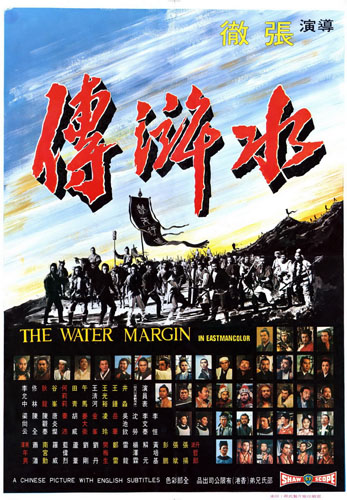
Hundreds of stuntmen and extras were employed for this production. They rode horses, swam, fought, and patrolled. And even though Jackie Chan claims to have been present during the filming, there is a problem: according to his account, two of his scheduled scenes were never actually filmed with him.
- swimming in the open sea with a knife in his mouth
- standing next to Ti Lung on a boat
And upon reviewing the footage, a second problem becomes apparent: namely, that these scenes do not appear in the film at all. Logically, our next step must be to examine the second film in the series.
But first, a quick note: “The Water Margin” opens with a montage of pirates, both at sea and on the beach, which is shown in greater detail in “All Men Are Brothers”. Could it be, then, that Jackie Chan was present on set as an extra after all, and that a few shots of him were subsequently cut into this sequence?
DELIGHTFUL FOREST (1972)
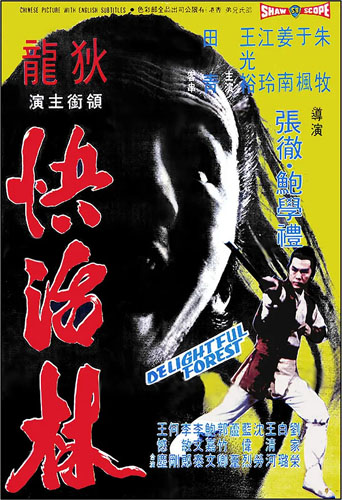
It is safe to assume that – given the brief interval of less than six months between the theatrical releases of the two films – they were shot either simultaneously or, at the very least, with overlapping schedules. This point alone may explain why Jackie Chan refers to the “Water Margin” film; after all, at the start of production, Chang Cheh’s trilogy for the Shaw Brothers was very likely treated as a single, cohesive project – a move that made perfect sense both thematically and logistically.
Although this film once again called for a large number of extras, the specific scenes described by Jackie Chan remain nowhere to be found. Let us, therefore, move directly on to the next film.
ALL MEN ARE BROTHERS (1975)
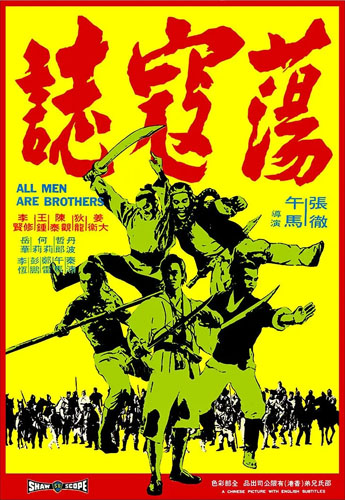
Even though the trilogy was produced consecutively – and the third installment was undoubtedly filmed well into 1973 – Bruce Lee‘s death in July of that year caused a massive slump at the box office; consequently, both production studios and distributors remained uncertain for a long time as to whether Hong Kong action cinema could ever be revived. Thus, “All Men Are Brothers”, like so many films of that era, was initially shelved, until it finally saw its official release in Hong Kong in May 1975.
Good things come to those who wait, and so Jackie Chan’s descriptions from that 1989 talk show appearance finally apply to this very film. Here, we see dozens of stuntmen swimming ashore with knives clenched in their teeth; we see them standing on boats; and we see the famous water gate, the very spot where he reportedly stood holding a weapon.
Unfortunately, due to the magnificent widescreen cinematography, we cannot really make out Jackie Chan among the cast members. However, based on his detailed descriptions of the set – something he did not manage to provide for every project from that early era – I personally count this film as 90% part of Jackie Chan’s filmography.
Incidentally, rumors suggest that an extended version, reportedly containing additional footage, may have existed in the Netherlands. Exactly how much footage is involved remains unknown; I am therefore filing this detail under the category of “requires further independent verification” – for, who knows, perhaps Jackie Chan himself might be found within that material as well? Anyone with information on the matter is kindly asked to come forward with supporting evidence.
However, my 2021 research for my podcast episode did not end there. Eager to learn more, I next turned my attention to the official spin-off film “Pursuit”, which was released back in 1972.
PURSUIT (1972)
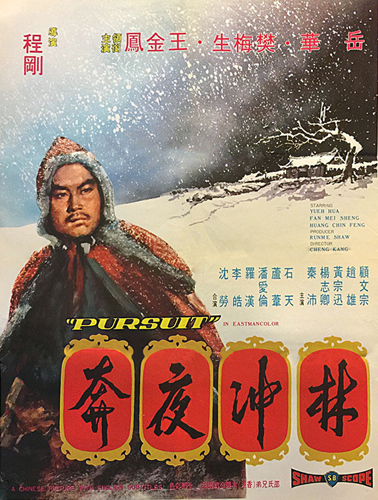
The mere fact that the aforementioned names – Chang Cheh, Lau Kar-Leung, Tong Kai, and Ti Lung – were entirely absent from this production provided me, even before I had watched the film, with sufficient circumstantial evidence that Jackie Chan would not be found in the scenes he had described. I was proven right: none of those descriptions apply to this film. Nevertheless, one can never definitively rule out Chan’s involvement in advance; after all, this production, too, features numerous fighting extras who are rarely clearly identifiable. The action choreography was handled by seasoned veterans of the Shaw Brothers studio and Bruce Leung.
TRILOGY OF SWORDSMANSHIP (1972)
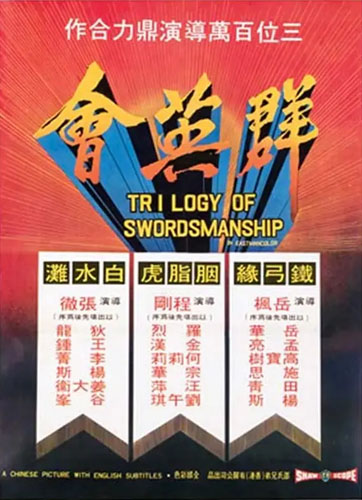
For the sake of completeness, I also watched this anthology film – directed by Chang Cheh, Tong Kai, and Lau Kar-Leung and starring Ti Lung – which does not belong to the canon of “Water Margin” films. A scene set on the beach, familiar from Chang Cheh’s trilogy, once again features a number of stuntmen in action; however, none of the scenes described by Jackie Chan can be found here.
THE PIRATE (1973)
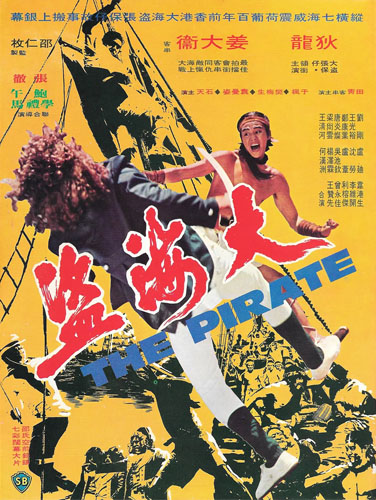
A final thematically related film – when it comes to pirates – that unites the entire troupe (with the possible exception of Jackie Chan?) is “The Pirate” from 1973. Indeed, one finds scenes here similar to those in “All Men Are Brothers” which was filmed around the same time and lists all the names from Chan’s narrative in its opening credits. We see pirates swimming ashore with knives clenched in their teeth, and we see them standing atop boats.
Even though the water gate sequence is absent this time around, the beach scenes feature two small stunts – often overlooked, despite being prominently staged – that could conceivably have been performed by Jackie Chan at that stage of his career. While we cannot yet definitively confirm whether Jackie Chan participated in this production, there are at least a few clues that the fan community might wish to investigate further.
Regardless of whether Chan was involved in “The Pirate”, the film is absolutely worth watching; one can clearly sense that it almost certainly served as an inspiration for “Project A” a decade later.
NOTE:
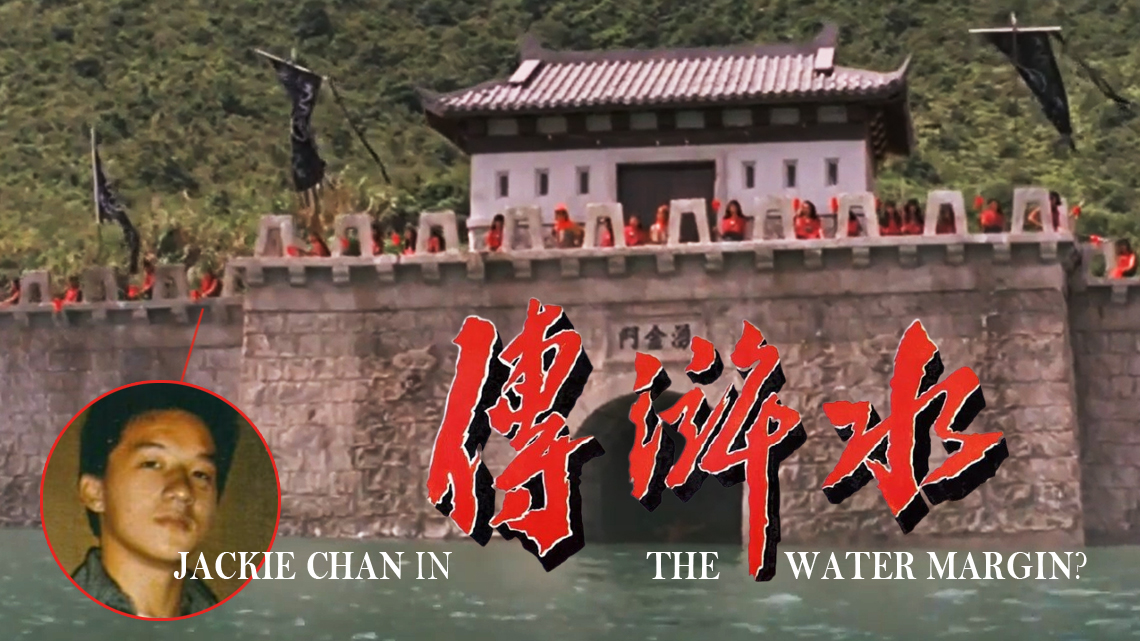
The cover image of this article depicts three unrelated elements: (a) a scene from “All Men Are Brothers” (1975); (b) a portrait photograph of Jackie Chan from that era – the red arrow points to an arbitrary spot, not necessarily to the specific location where Jackie Chan might have stood during filming; and (c) the original Chinese title lettering for “The Water Margin”.
“The Water Margin” filmography with explanations
To bring my research findings to a definitive conclusion, I will wrap up by listing – once again – all the films discussed here, presented in chronological order of their initial release and accompanied by a brief note. Unlike in my article “1960-1969: Jackie Chan’s first steps – A look back at lost and rediscovered films” (🔗), I distinguish here between the following three criteria:
🟢 = all keywords met, thus indirectly confirmed by JC
🟡 = certain keywords met, needs further investigation
🔴 = probably no reference
17 March 1972
🟡 The Water Margin | 水滸傳
None of the scenes described by Jackie Chan can be found here (except for a montage in the beginning of the film); consequently, he cannot have participated in them – though his involvement as an extra and/or stuntman remains possible, regardless of his claims.
11 May 1972
🔴 Trilogy Of Swordsmanship | 群英會
This film, too, contains none of the scenes described by Jackie Chan; consequently, he cannot have participated in it.
1 June 1972
🔴 Pursuit | 林沖夜奔
Excluded solely for the sake of completeness; neither the cast, the crew, nor the described scenes align with Jackie Chan’s accounts.
20 September 1972
🔴 Delightful Forest | 快活林
This film, too, contains none of the scenes described by Jackie Chan.
27 September 1973
🟡 The Pirate | 大海盜
Scenes similar to those in “All Men Are Brothers” can be found here. Furthermore, there are two stunts on the beach that Jackie Chan could technically and theoretically have performed himself; however – regardless of whether he actually executed them – his involvement as an extra and/or stuntman remains a possibility that requires separate verification.
10 May 1975
🟢 All Men Are Brothers | 蕩寇誌
All the scenes described by Jackie Chan can be found here. Even though the widescreen footage means we cannot make out a young Chan, it is almost certain that Jackie Chan appeared on screen in this film. The definitive proof – of him standing by the water gate with a gun – has yet to be provided, but I still consider “All Men Are Brothers” to be 90% part of Jackie Chan’s filmography.
I am almost certain that, in the future, we will uncover clearer photographic and video evidence corroborating Jackie Chan’s accounts and the arguments presented here. Anyone wishing to actively assist in this endeavor is cordially invited to get in touch with me.

