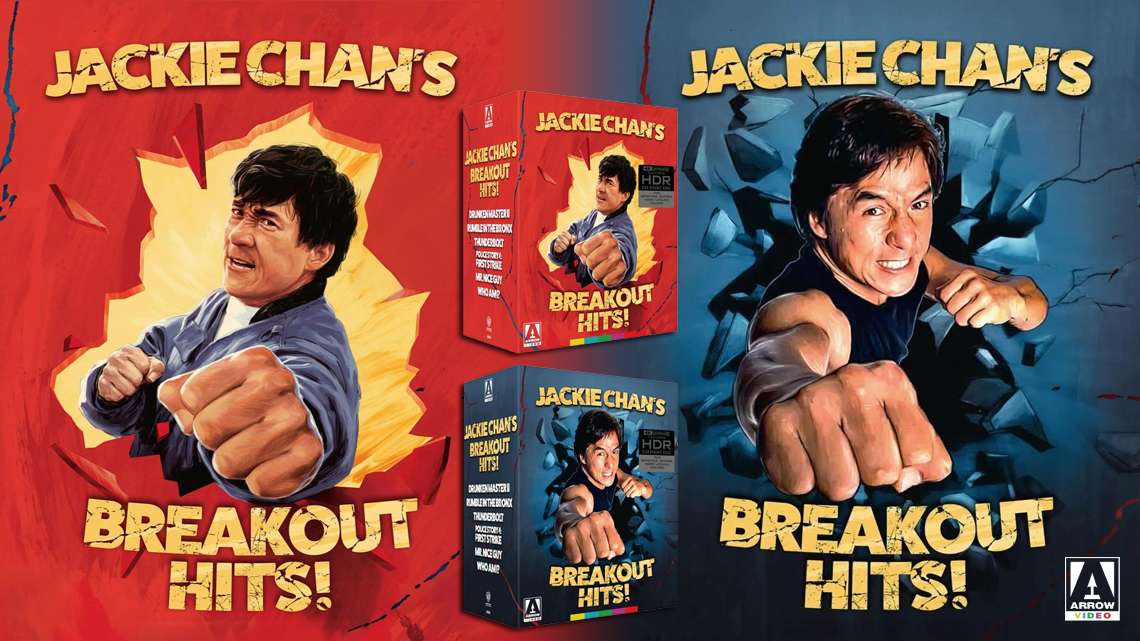
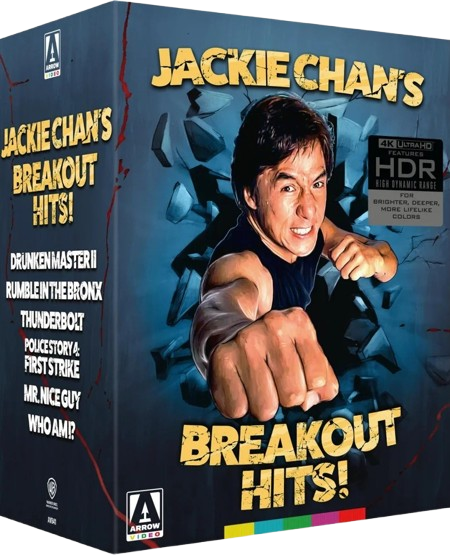
Arrow Video announces “Jackie Chan’s Breakout Hits!” box set including six 4K films from the 1990s
Arrow Video’s announcement that they will finally release six of Jackie Chan’s 1990s hits in 4K in the summer of 2026 has sent Chan fans worldwide into a frenzy. The box set, titled “Jackie Chan’s Breakout Hits!”, is already generating heated discussions among film collectors even before its release.
For many years, indeed decades, the Warner Archives were firmly locked away. Much to the dismay of many Jackie Chan fans, who, as children in the 1990s, were first infected by the Chan fever and his films like “Thunderbolt,” “Mr. Nice Guy,” and “Who Am I?” and have remained true fans to this day. For this generation, the new box set from Arrow Video represents a dream come true in 4K.
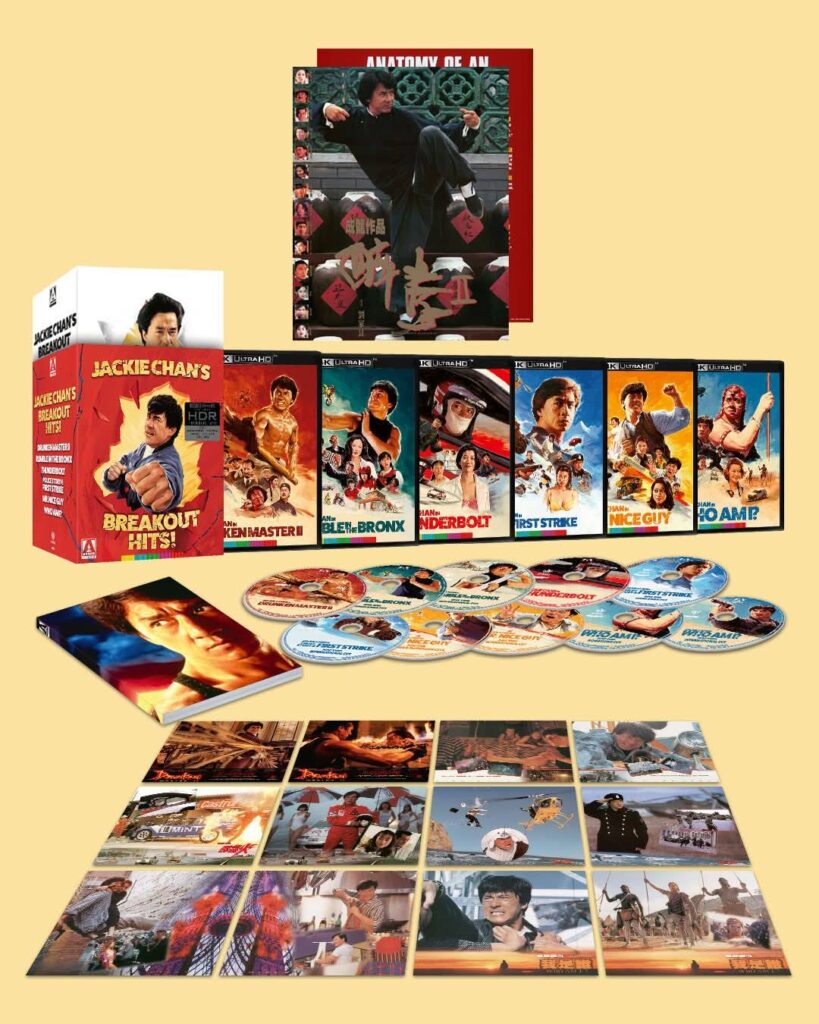
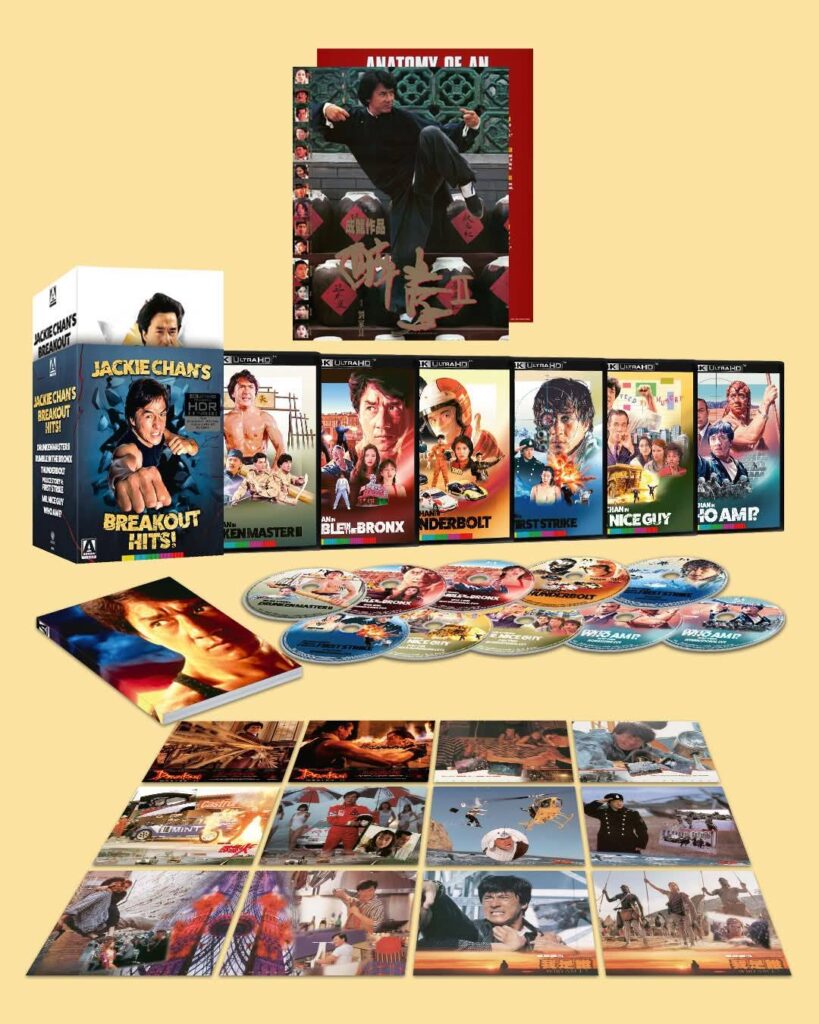
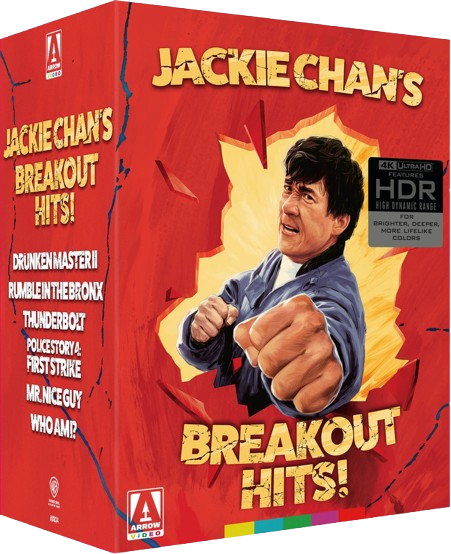
Across 10 discs, you’ll find various cuts of the films “Drunken Master II,” “Rumble in the Bronx,” “Thunderbolt,” “Police Story IV: First Strike,” “Mr. Nice Guy,” and “Who Am I?” with all sorts of new bonus material. The box set, available in two artwork variations, also includes a 160-page booklet, 24 reproductions of lobby cards, and a double-sided poster. What more could fans want? Besides the two cover variants – the blue one, the Arrow Exclusive, shows the famous promo image of Chan from the “Rumble in the Bronx” era; the red one features a similar image, but of Chan in the film “Who Am I?” – the title of the box set is causing some discussion online.
Are these really Jackie Chan’s “breakout hits”?
In film circles, the term “breakout hit” has been defined as a film that achieves unexpectedly great commercial or cultural success and/or launches the careers of those involved. This definition is also used by dictionaries. However, a simple definition cannot be so easily applied to a global superstar like Jackie Chan, who has been active in the film industry since the early 1960s.
Therefore, the following questions arise regarding the films included in this box set:
- Was the film a commercial success?
- Was the film a cultural success?
- Did the film help Jackie Chan achieve his breakthrough?
We need to be even clearer when we consider the countless different markets around the world:
- Why was the film a commercial success?
- In what way was the film a cultural success?
- In which market did the film help Jackie Chan achieve his breakthrough?
And when we look at the different media, we must also be completely honest and ask ourselves whether, from today’s perspective, we might be underestimating the VHS and DVD market of the 1990s.
Box Office vs cultural relevance
Many consider “Drunken Master II” to be Jackie Chan’s last classic film. In 1994, it ranked second at the box office, behind Wong Jing’s “God of Gamblers Return” with 52.52 million HKD, for a total gross of 40.97 million HKD. By filming in several Chinese cities, Jackie Chan laid the groundwork early on for a wide release in mainland China; it earned an additional 10 million Yuan on the mainland and helped Golden Harvest conquer the opening Chinese film market.
This success was further cemented with “Rumble in the Bronx,” which topped the Hong Kong box office charts in 1995 with 56.91 million HKD. The film received a massive promotional campaign throughout China and grossed a remarkable 100 million Yuan there. What happened with “Rumble in the Bronx” during 1995, 1996 and afterwards could be described as Chan’s global breakthrough, which led to lucrative deals with Miramax/Dimension Films and New Line Cinema, which in turn served Jackie Chan as a brand to the West on a silver platter in a media-friendly way.
With “Thunderbolt,” Chan took second place that same year with 45.64 million HKD in box office receipts. Across Asia and mainland China, its success was solid, but not comparable to its predecessor. Chan’s car racing film is still largely overlooked, but it’s worth examining more closely due to his long-standing relationship with Mitsubishi.
In 1996, Jackie Chan set a new box office record in Hong Kong with “Police Story IV: First Strike,” grossing 57.51 million HKD. Even in China, the film earned 112 million Yuan. “Mr. Nice Guy,” filmed almost immediately afterward, also in Australia, reclaimed first place in 1997 with 45.42 million HKD and a strong box office in China, but overall, box office numbers declined in the late 1990s in general. “Who Am I?” also experienced this decline. It didn’t help matters: only second place in 1998 and 38.85 million HKD in revenue.
Back to the home video roots
So how can we, in good conscience, speak of Jackie Chan’s breakout hits? Because success isn’t solely measured in numbers. All of the aforementioned films were strong video store releases from the late 1990s well into the 2000s, thus helping Jackie Chan become a household name in the West; back then, cinemas and video stores complemented each other perfectly. This shouldn’t be overlooked, especially considering the then-emerging Chinese market.
Arrow Video will likely manage to release the home cinema release of the year, perhaps even the decade, this summer, thus making six absolute action-comedy hits from Jackie Chan not only available to old veteran fans, but ideally also introducing them to a new, young audience. And who knows, perhaps this audience will then appreciate physical media more than on-demand streaming – I speak on behalf of all those who had to make their first Chan film experiences in 4:3 in pan & scan mode and were still amazed.
Each of these films in the upcoming box set thus catered to different markets and target audiences, cleverly connecting Chan’s other ventures, of which he already ran numerous before “Drunken Master II”. I explain in detail how this worked in my essay exclusively for Arrow Video’s “Jackie Chan’s Breakout Hits!”

